I pretty often see people asking questions online, usually in solo camping forums or motorcycle camping forums or groups, what gear do you take?
A major question, is what kind of camping are you intending to do? If you travel on a motorbike and put up your tent in official campgrounds? Or, if you stealth camp? Do you cook your own food? Do you do a mixture of these?
Personally, I travel fully equipped to stealth camp and to cook my meals. Obviously, this means carrying a little extra gear with you (and, of course, on your bike).
Some people don't camp. They ride a motorbike and travel with the same full protective gear and spare clothing. But, if you're not camping, there's no need for tent, sleeping bag, cooking stuff or food. Much lighter and less volume, and easier too. To each their own tastes and budget.
After a few trips, you start to slim down your list of stuff and to get rid of what you don't need. Better yet, you start to find dual purpose items, and also to live a bit more minimally.
My Personal list of Gear:
- Tent: I use a Decathlon MT900 2 person tent (€250) it says 2 people, but you'd better be really, really good friends with the other person. I prefer to say it's one person and their motorbike clothing. The helmet and boots stay under the outer tent skin, but not inside the sleeping area. I like this tent. Only 1.95kg
- Sleeping bag : Again, Decathlon, this is a Simond M500 down sleeping bag, (€100) rated for minus 5°C. By the way, temperature ratings for sleeping bags are not necessarily comfort temperatures, but survival temperatures. At 8 degrees Celsius with my MT500 sleeping bag, I wear long undies and socks too . Why choose a down-filled sleeping bag, rather than synthetic? Synthetic has the advantage of being quick-drying, but down sleeping bags win on volume; you can compress down, but not the synthetic insulation.
- Air mattresses; I've tried, the very lightweight inch-thick self-inflating trekking mattresses, Temu foot-pump inflated air mattresses and now, finally settled on a Swiss company's air mattress, that's probably made in China, but to the kind of quality that Swiss insist upon. (€75) it's very comfortable, but sweaty in the hot weather. If you camp in summer heat, you will sweat. You will survive it, it's life; get over it.
- Cooking stove: I use an Optimus Nova stove. (€150) They are a Swedish company, now owned by a Swiss company names Katadyn. The advantages of this stove are many: It will burn pretty much any liquid fuel. They will burn Petrol, Diesel, Kerosene, White Spirit, Rubbing Alcohol, even vodka (it's a waste)! What this means for me, is that the fuel bottle full of petrol I use for my stove is also my reserve supply of petrol for the motorbike. That litre of petrol can avoid a long walk, if I ran out of fuel for the bike. Other than that, the stove is very robust and simple to maintain. I've had (trekking) experience with travel in Argentina, Chile and Costa Rica and in those places the camping gaz international cartridges we see in Europe are non-existant, or at least they were. If you travel to Morocco, gas cartridges are not the same here as in Europe. By using the optimus stove, anywhere I can go on a motorbike, I can get fuel to cook. I earn nothing if you click the link: It's there to inform you.
- Cooking pans: I have cheap stainless steel (Temu) pans and lids. One bigger saucepan, and one smaller. The lids can be used as a plate or a frying pan. You can cook a two-pot meal, plus a cup of coffee. My dishwashing gear (sponge and dish soap) are stored inside the nested saucepans, and the saucepans in a ziplock bag in case of leaks. The dish soap or washing-up liquid, doubles as shampoo.
- Swiss Army knife: I have, and use frequently, the "Camper" model. I find it a good compromise between weight and capabilities. It's my principal knife for cooking or eating, and doubles up for lots of little "fixit" jobs. Some people like to use a Leatherman tool, or equivalent.
- I have a stainless steel fork and soup spoon. For a knife I use the Swiss Army knife.
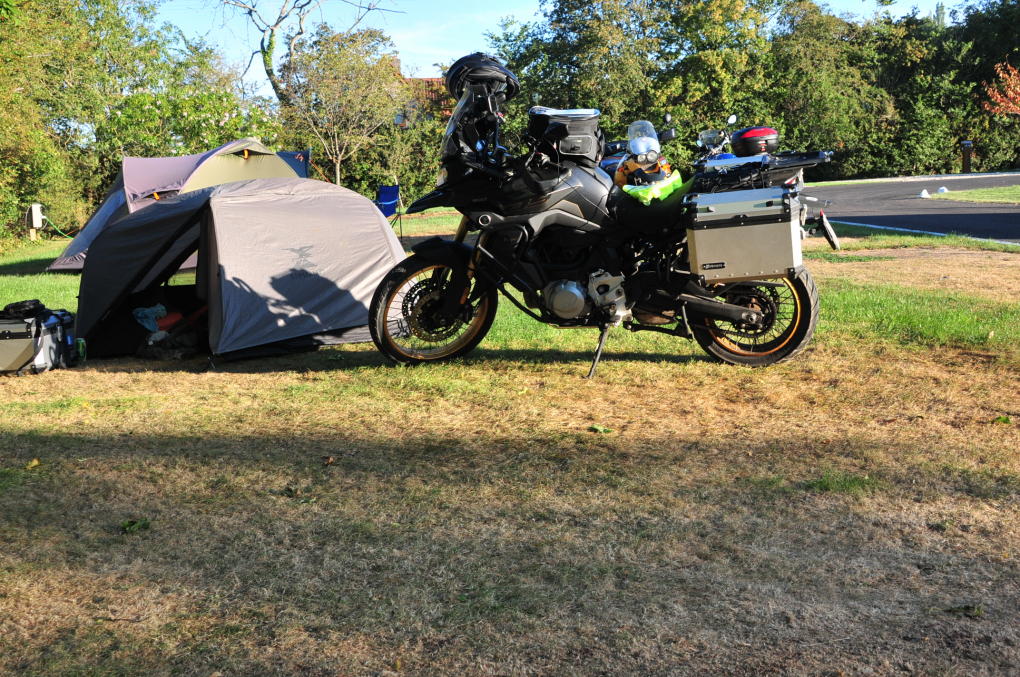
- When I travel, I have twin aluminium panniers, 36l each. They are lockable and waterproof, as is the 55 litre top case. In a campsite, one pannier is my stool and the top case is my table. Soft luggage is good for off-road, but on-road travel, aluminium hard luggage is king.
- Various stuff: A pair of waterproof socks, spare clothing, balaclava, latex gloves, motorbike basic toolkit, chain lube, a few cable ties, a small roll of sticky tape. Vitally important is a square of ultra cheap exercise mat. This is for standing on in wet grass or muddy ground for putting on motorbike boots or sneakers. I have a rechargeable headlamp for hands-free lighting. Another thing that you need, but which took me two voyages to find out is 8 metres of 5mm cord. It's for drying your clothes after they're washed.
- A square of plywood with two metres of cord (same cord as the washing line) attached. When you arrive on muddy ground or sand with a heavy bike and luggage, hold the string, drop the plywood and nudge it under the side stand. Tie the loose and to the handlebars, so you can retrieve it when you leave.
- Other than that, I have a tubeless repair kit and CO2 cartridges to inflate tyres. I also carry a Motowinch LC2500 dispositive (€ 230) for lifting my bike if I drop it. I also use it for greasing the chain. I have no affiliation with Eastbound, I earn nothing from it, I just think it's a useful tool to know about. Before you say I should be capable of picking up a bike myself or buy lighter bikes, I have had several surgeries on my vertebrae. I'm not supposed to lift more that 30kg. For the Motowinch,I don't have the optional soft-ground larger foot: my plywood does that.
All my clothes go in a soft bag inside the top case. It can be carried as a rucksack. Everything in the luggage is stored in separate drybags, to avoid one wet thing wetting others, or to avoid, say, leaked soap getting everywhere. The tent travels on the pillion seat, held on by an elastic net, inside a drybag.
I carry about 6 synthetic T shirts and two lightweight synthetic pairs of trousers and one pair of trainers besides my bikers' gear. I wash clothes once a week, sometimes in camp sites, or, in France or Portugal Intermarché supermarkets have washing and drying machines for public use.
Some people i read on forums, buy cheap clothing, then just throw it away and buy new. What a waste and how ridiculous.
When I sleep, my towel, damp or otherwise, is my pillow. For food, I carry knorr dried soups, rice in a ziploc, instant coffee in a ziploc, sugar in a ziploc and a small vitamin plastic bottle of salt. One gas lighter and a box of storm matches.
Anything that needs charging is charged on the bike. I have a quadlock induction charger for the phone, and I unplug and use that USB supply to charge headlamp, toughened outdoor tablet and helmet intercom (for navigation purposes).
All of this gear fits inside my two 36l aluminium panniers, with the exception of the tent, which, as I said, lives on the pillion seat in a dry bag. All my clothes, except my motorcycle clothes are in a soft bag inside the 55l top case, along with my things for brushing teeth and shaving. I chose the aluminium cases for peace of mind when traveling alone: I can lock them.
I also have a tank bag, made by Givi. It's a bit big, but inside, I can put a digital reflex camera with a 24 to 300 mm zoom, a spare battery, a bottle of water with electrolytes, first aid kit, lip cream, all the odds and sods I don't know where to put otherwise. In a side pocket, is a credit card for traveling on toll roads. The bag has a transparent top, where I put the relevant paper map. I never rely on just google maps or TomTom. The tank bag has a waterproof cover (also transparent top) for heavy rain.
Talking of rain, I have a 36 € waterproof hi vis rain coverall for very wet weather.
My keys (keyless ignition) and papers and wallet go in my jacket pockets.
Food and Drink:
When I set off, I carry some basic food in ziplock bags: Rice, Pasta, Coffee, Porridge oats, Sugar and dried soups, such as knorr soups. The soups, boiled in water and eaten with fresh bread make a tasty, salty, meal. If you boil the rice, or the pasta in the soup, it's a more filling consistency. After a whole month of eating this kind of thing, while it fulfills its role of fuel for the body, tends to leave cravings for things like chocolate, or indeed, anything tasty. Don't be tempted to buy a can of fish to mix with your rice, unless you have really good washing-up liquid, or don't mind everything tasting of fish. Don't ask me how I know this.
I always take something to keep a small quantity of salt in. My last trip, it was an empty plastic vitamin bottle, with a tightly closing lid. Or you can buy from sports stores that have camping equipment.
Buying food in supermarkets is both easy and difficult. Easy because they are everywhere, hard because they have a nasty tendency to package things in "family sized" quantities. Some things can be bought by weight, in small quantities, mostly vegetables and fruits. In my experience, the fruit is rarely ripe, and you have no way of waiting until it is. This led me to the temptation of buying oranges from a roadside producer's stand in Spain. I ended up with 20 kilos of oranges, when I wanted two oranges.
Eggs, sometimes, you can buy four: Fry two and boil two. The boiled eggs will be fine for another day. So far, I haven't tried to transport uncooked eggs. I reckon it's do-able, using a plastic tupperware-style box, using empty ziplocs or clean socks as padding. I'll try next time.
Ham: Boiled ham should be eaten immediately. Dry-cured ham can be kept for a few days, although it will sweat and be greasy.
Sausages: Buy a small package (often 8) and fry them all. Eat some and keep the rest to eat cold next day.
Instant pots or instant meals: Just add boiling water and have an instant, disgusting meal. It's fine if you like it. I don't. The only thing I like about them are they're very heavily laden with salt.
My last camping meal: 3 potatoes, boiled, 1 leek, boiled with the potatoes, the whole, drained and mashed, with added salt. Two fried eggs. Water with the meal, coffee afterwards and a beer to follow.
Loading your bike:
The art of loading your motorbike is really pretty simple: you'll want to pack so that the heaviest things are carried as low as possible on the bike. I choose to put my tools at the bottom of the panniers, sharing the weight between both sides, trying to keep items that should be together as close together as I can. I gradually pack the lighter stuff as the pannier fills.
There is one exception to where tools are stored. As I mentioned in another post (?????) I have a Motowinch to lift a dropped bike. It goes on top of the tent. Imagine dropping the bike and having a trapped leg? Or having the dropped bike laying on the pannier where you stored the motowinch? Nope, it needs to be accessible. Mine goes on top of the tent, on the pillion.
It's not a hard and fast rule, for instance, I buy my mineral water at the end of the day. It goes on top off all the other stuff in the panniers. I've had no issues at all.
When I'm riding on a long hop, with no food or water in the panniers, the tent goes inside a pannier.
Once I've done my food and drink shopping, there's not enough room in the panniers, so the tent has to go on the pillion seat, held on with an elastic net. It could also be strapped to the lid of one of the panniers.
I don't worry too much about the weight I'm carrying in total; If you have a pillion rider, you're taking more weight anyway. Maybe if you're two up and camping, you have to take it into consideration.
Views: 0